Oud


The oud is a pear-shaped stringed instrument commonly used in North African  and Middle Eastern music. The modern oud and the European lute both descend from a common ancestor via diverging paths. The oud is readily distinguished by its lack of frets and smaller neck.

Name

The origin of the name oud (and its etymological cousin, lute) for the musical instrument is uncertain, but the Arabic العود (al-ʿūd) refers literally to a thin piece of wood similar to the shape of a straw, and may refer to the wooden plectrum traditionally used for playing the oud, to the thin strips of wood used for the back, or to the wooden soundboard that distinguished it from similar instruments with skin-faced bodies. Recent research by Eckhard Neubauer suggests that oud may simply be an Arabic borrowing from the Persian name rud, which meant string, stringed instrument, or lute.

The Arabic definite article al- was not retained when al-ʿūd was borrowed into Turkish, nor was the letter ʿayn, the sound of which (a voiced pharyngeal fricative) does not exist in Turkish. The resulting Turkish word is simply ud (with a pronunciation similar to the word food without the f).

The oud was most likely introduced to Western Europe by the Arabs who established theUmayyad Caliphate of Al-Andalus on the Iberian Peninsula in 711. Oud-like instruments such as the Ancient Greek Pandoura and the Roman Pandura likely made their way to the Iberian Peninsula much earlier than the oud. However, it was the royal houses of Al-Andalus that cultivated an environment that raised the level of oud playing to greater heights and boosted the popularity of the instrument. The most famous oud player of Al-Andalus was Ziryab. He established a music school in Córdoba, enhanced playing technique and added a fifth course to the instrument. The European version of this instrument came to be known as the lute – luth in French, Laute in German, liuto in Italian, luit in Dutch, laúd in Spanish, and alaúde in Portuguese. The word “luthier”, meaning stringed instrument maker, is in turn derived from the French luth. Unlike the oud, the European lute utilizes frets (usually tied gut).

History

According to Farabi, the oud was invented by Lamech, the sixth grandson of Adam. The legend tells that the grieving Lamech hung the body of his dead son from a tree. The first oud was inspired by the shape of his son’s bleached skeleton.

The oldest pictorial record of a lute dates back to the Uruk period in Southern Mesopotamia(modern Nasiriyah city), over 5000 years ago on a cylinder seal acquired by Dr. Dominique Collon and currently housed at the British Museum. The image depicts a female crouching with her instruments upon a boat, playing right-handed. This instrument appears many times throughout Mesopotamian history and again in ancient Egypt from the 18th dynasty onwards in long and short-neck varieties. One may see such examples at the Metropolitan Museums of New York, Philadelphia, Cleveland, and the British Museum on clay tablets and papyrus paper. This instrument and its close relatives have been a part of the music of each of the ancient civilizations that have existed in the Mediterranean and the Middle East regions, including the Sumerians, Akkadians, Persians, Kurds, Babylonians, Assyrians, Armenians,Greeks, Egyptians, and Romans.

The ancient Turkic peoples had a similar instrument called the kopuz. This instrument was thought to have magical powers and was brought to wars and used in military bands. This is noted in the Göktürk monument inscriptions, the military band was later used by other Turkic state’s armies and later by Europeans. According to musicologist Çinuçen Tanrıkorur today’s oud was derived from the kopuz by Turks near Central Asia and additional strings were added by them.

Today’s oud is totally different from the old prototypes and the Turkish oud is different from the Arabic oud in playing style and shape. The Turkish oud is derived from modifying the Arabic oud: its development has been attributed to Manolis Venios, a well known Greek luthier who lived in Istanbul in the late 19th and early 20th centuries. In Greece and Armenia musicians use the Turkish ouds and tunings.

The oud has a particularly long tradition in Iraq, where a saying goes that in its music lies the country’s soul. A ninth-century Baghdad jurist praised the healing powers of the instrument, and the 19th century writer Muhammad Shihab al-Din related that it “places the temperament in equilibrium” and “calms and revives hearts.”[9] Following the invasion of Iraqand the overthrow of the secular Ba’athist regime in 2003, however, the increasing fervor of Islamic militants who consider secular music to be haraam (forbidden) forced many oud players and teachers into hiding or exile.

Defining features

o       Lack of frets: The oud, unlike many other plucked stringed instruments, does not have a fretted neck. This allows the player to be more expressive by using slides and vibrato. It also makes it possible to play the microtones of the Arabic Maqam System. This development is relatively recent, as ouds still had frets in AD 1100, and they gradually lost them by AD 1300, mirroring the general development of Near-Eastern music which abandoned harmony in favor of melismatics.

o       A tapering neck: The oud, unlike the lute, the mandolin and the guitar, has a tapering neck with courses of strings converging towards one another at the pegbox end. The parallel courses found in lutes, mandolins and guitars are not necessary as music in the maqam system does not consist of series of chords.

o       Strings: With some exceptions, the modern oud has eleven strings. Ten of these strings are paired together in courses of two. The eleventh, lowest string remains single. There are many different tuning systems for the oud which are outlined below. The ancient oud had only four courses — five by the 9th century. The strings are generally lighter to play than the modern classical guitar.

o       Pegbox: The pegbox of the oud is bent back at a 45-90° angle from the neck of the instrument. This provides the necessary tension that prevents the pegs from slipping. The tension of the strings helps to hold what would otherwise be a weak joint together. The nut is held in place by the string tension, rather than being glued. The pegs do not slip if tapered accurately; if they do, chalk is used to make them stick more, and soap to enable them to slip more. Proprietary compounds or pastes, sometimes called pegdope are also used.

o       Body: The oud’s body has a staved, bowl-like back resembling the outside of half a watermelon, unlike the flat back of a guitar. This bowl allows the oud to resonate and have a particular tone quality. The shape is structurally very strong and stable enabling it to be very thin. It can be 1.2 mm. Although made of dense hardwood, good instruments are not heavy. The guitar structure would not be stable if the build were as light.

o       Sound-holes: The oud generally has one to three sound-holes, which may be either oval or circular, and often are decorated with a carved bone or wooden rosette.

Construction

Construction of the oud is similar to that of the lute. The back of the instrument is made of thin wood staves glued together on edge. Alternating staves (or ribs) of light and dark wood are often used. The instrument usually has an odd number of staves. This means the back will have a center stave rather than a center seam. Contrasting trim pieces are often used between staves. Patterns and wood species used generally vary from maker to maker. In better instruments the wood is always cut on the quarter from a dense hardwood.

The top of the oud is generally made of two matching pieces of thin spruce glued together on edge. Transverse braces, also of spruce, are glued to the underside of the top.

The neck is generally made of a single piece of wood and is usually veneered in a striped pattern similar to that of the back. The pegbox meets the neck at a severe angle. The pegbox is usually made from separate side, end and back pieces glued together.

Regional types

The following are the general regional characteristics of oud types in which both the shape and the tuning most commonly differ:

    • Arabic ouds: Slightly larger, slightly longer neck, lower in pitch.
    • Syrian ouds: The basic design, with less decoration
    • Iraqi (Munir Bashir type) ouds: Generally similar in size to the Syrian oud but with a floating bridge which focuses the mid-range frequencies and gives the instrument a more guitar-like sound. This kind of oud was developed by the Iraqi oud virtuoso Munir Bashir. Iraqi ouds made today often feature 13 strings, adding a pair of higher pitched nylon strings to a standard Arabic oud configuration.
    • Egyptian ouds: Similar to Syrian and Iraqi ouds but with a more pear shaped body. Slightly different tone. Egyptians commonly are set up with only the 5 courses GADGC. Egyptian Ouds tend to be very ornate and highly decorated.
    • Greek ouds (“ud, ούτι”) (Includes instruments found in Armenia and Turkey): Slightly smaller in size, slightly shorter neck, higher in pitch, brighter timbre. It’s known as outi in Greece and was used by early Greek musicians.
    • Persian/Iranian Oud (barbat): smaller than Arabic ouds with different tuning and higher tone. Similar to Greek ouds but slightly smaller. The original barbat, a predecessor of the oud, had tied frets like those of a tar, setar or lute, but today these are not used.
    • Oud Qadim: a type of small-bodied oud with four courses of strings from North Africa, now out of use.

Although the Greek instruments laouto and lavta appear to look much like an oud, they are very different in playing style and origin, deriving from Byzantine lutes. The laouto is mainly a chordal instrument, with occasional melodic use in Cretan music. Both always feature movable frets (unlike the oud).

Plectrum (pick

The plectrum (pick) for the oud is usually a little more than the length of an index-finger. The Arabs traditionally used thin piece of wood as a plectrum, later replaced by the eagle’s feather by Zyriab in Spain (between 822 to 857), other sources state that he is the first one to use the wooden plectrum.

To date the Arabic players use the historic name reeshe or risha (Arabic: ريشة‎), which literally means “feather” while Turkish players refer to it as a mızrap. Currently the plastic pick is most commonly used for playing the oud, being effective, affordable, and widely available.

Like similar strummed stringed instruments, professional oud players take the quality of their plectrums very seriously, often making their own out of other plastic objects, and taking great care to sand down any sharp edges in order to achieve the best sound possible.


Arnold of Brescia


Arnold of Brescia (c. 1090 – c.1155), also known as Arnaldus (Italian: Arnaldo da Brescia), was a monk from Italy who called on the Catholic church to renounce ownership of property, led the Commune of Rome’s temporary overthrow of papal rule, and was later hanged by the Church for treason.

Born in Italy, Arnold became an Augustinian monk and then prior of a monastery in Brescia, possibly studying at some point withPeter Abelard in Paris. Witnessing the corrupting influence of wealth on the clergy, he became critical of the temporal powers of the Catholic Church, calling on his local bishop to renounce property ownership and return church lands to the city government. Arnold was condemned for this at the Second Lateran Council 1139. He soon stood trial with Abelard at Sens, where both men were sentenced to silence and exile as a result of the accusations of Saint Bernard of Clairvaux.

Disregarding his sentence, Arnold continued to teach, but eventually came to Rome to seek reconciliation with Pope Eugene III. There, he found the city in turmoil and joined the cause of the Commune of Rome. His leadership was crucial in forcing Eugene to leave the city and restoring Roman democracy for several years.

Although his political cause ultimately failed, Arnold’s teachings on apostolic poverty continued to be influential after his death among the Waldensians and the Spiritual Franciscans. Catholic tradition condemns him as a rebel and sometimes as a heretic, but Protestants rank him among the precursors of the Reformation.

Life

Born at Brescia, toward the end of the eleventh century, Arnold aspired to a perfect life from his youth. Before reaching adulthood, he entered a monastery in his native city, where he was ordained a priest and later appointed prior of his community. Arnold reportedly completed his studies at some point under the direction of Peter Abelard. If the report is accurate, he must have gone to Paris around 1115. Whether or not he actually studied with Abelard, it seems clear that Arnold was influenced by his ideas.

Even his detractors admit that Arnold was qualified for the high office of provost/prior at Brescia by his detachment from earthly things, his love of religious discipline, and the clearness of his intellect. Arnold also possessed an originality and charm of expression that he brought to the service of a lofty ideal. Brescia yielded to his influence, and in the course of several years Arnold advanced to be the unrivaled head of the reform movement then stirring the city.

Brescia, like most other Lombard cities, was beginning to exercise its municipal rights. The government was in the hands of two consuls elected annually. Checking their authority was the local bishop, who was also a principal landowner. Inevitable conflicts arose between the rival forces, involving not only political and economic issues, but also religious passions. These conditions grieved Arnold. He pointed out the evils which afflicted both the city and the Church, concluding that the chief causes of these sins were the corrupting wealth of the clergy and the temporal power of the bishop. He hoped for the Church to return to a more purely spiritual tradition, which would also give it the moral power it lacked as a major landowner with powerful political interests. He advised taking the immediate and drastic measure of stripping the monasteries and bishoprics of their wealth, and transferring it to the laity. This, he held, was the surest and quickest method of satisfying the civil authorities and of bringing back the clergy to the practice of theapostles.

To reduce this to a working theory, Arnold reportedly formulated the following propositions: “Clerics who own property, bishops who hold regalia [royal land grants], and monks who have possessions cannot possibly be saved. All these things belong to the [temporal] prince, who cannot dispose of them except in favor of laymen.”

The higher clergy, of course, vehemently rejected Arnold’s teachings, but elements in the growing middle class welcomed them. Brescia was thrown into crisis, although the details are not clear, due to the scarcity of documents. Some facts, however, seem certain. First, a journey was made by the local bishop, Manfred, to Rome about 1138. Then, an insurrection arose at Brescia during his absence. Finally, Arnold allegedly attempted to prevent the bishop’s exercise of temporal power when he returned.

Condemnation

Arnold sought to justify his revolt and appealed to Rome, but was condemned by Innocent II at the Lateran Council, in 1139. The pope commanded Arnold to keep silent and sent him into exile. He was forbidden to return to Brescia without the express permission of the pontiff.

The issue of Arnold’s teachings also came before the Synod of Sens in 1140. There, Arnold could be found by the side of the famous Abelard, who was about to make his final struggle in defense of his own views. Opposing them both was the equally famous Bernard of Clairvaux, whose intellect matched Abelard’s and whose piety out-shone even that of the ascetic Arnold. Accounts written by the victors portray the debate as an utter rout in favor of the conservative Bernard.

Both men were condemned to perpetual confinement in separate monasteries, a sentence that was confirmed by Innocent II in his bull dated July 16, 1140. Arnold’s writings were also condemned to be burned, as were Abelard’s, as a further measure. None of Arnold’s writings survive, and his teachings are known only through the reports of his enemies.

On the run

Abelard publicly recanted his views and took refuge with Peter the Venerable, the abbot of Cluny. The younger and more rebellious Arnold was less compliant. He retired temporarily to the Abbey of Sainte-Geneviève in Paris, where he soon opened public courses of moral theology, continuing to preach his radical ideas concerning apostolic poverty. According to John of Salisbury, he attracted disciples mainly from the impoverished people of the city who were so needy that they had to beg their daily bread. This, however, accorded very well with Arnold’s teachings, which sharply censured the luxury of bishops and the worldly possessions of monks. Wealth, Arnold insisted, was the real virus that was infecting the Church.

Arnold’s attacks did not stop here, however. He engaged his harsh diatribes against those who had condemned Abelard and himself. Arnold was particularly harsh in is criticism of Bernard of Clairvaux as a man “puffed up with vainglory, and jealous of all those who have won fame in letters or religion, if they are not of his school.” Bernard, on the other hand, denounced Arnold to Louis VII as “the incorrigible schismatic, the sower of discord, the disturber of the peace, the destroyer of unity.” Bernard, having succeeded in forcing Arnold out of Italy earlier, took satisfaction in reporting to his readers that, “The most Christian King drove (him) from the kingdom of France.”

Thus compelled to flee again, Arnold took refuge in Switzerland. The tireless Bernard continued in pursuit of his foe. By 1143, Arnold had left for Bohemia, where he begged protection from a papal legate, Cardinal Guido, who was touched by his misfortunes and treated him with friendliness. This attitude vexed Saint Bernard, although it may be that Arnold had given Guido pledges of submission to the pope’s will.

Career and death in Rome

Arnold soon returned to Italy to make his peace, in 1145, with Pope Eugene III. The pontiff, on reconciling him with the Church, imposed a form of penance then customary: Fasts, vigils, and pilgrimages to the principal shrines of Rome.

Rome itself, however, was now in the throes of its own secularizing reform. When Arnold arrived, he found that the followers of Giordano Pierleoni had asserted the ancient rights of the Roman republic. They took control of the city from papal forces and founded a republic, the Commune of Rome.

Arnold, no doubt seeing God’s providence at work, sided with the commune and soon rose to its intellectual leadership, calling for liberty and democratic rights. Arnold reportedly went so far as to declare that clergy who owned property had no power to perform the sacraments. The Curia became the chief object of his attacks; he depicted the cardinals as vile hypocrites. He accused Eugenius himself of being more concerned “with pampering his own body and filling his own purse than with imitating the zeal of the Apostles whose place he filled.” Arnold especially reproached the pope for relying on physical force, and for “defending with homicide” his own power. His preaching and the support of the commune succeeded in driving Pope Eugene into exile in 1146. From 1146-49, Roman democracy triumphed under Arnold of Brescia.

For this, Arnold was excommunicated, on July 15, 1148. However, when Pope Eugene returned to the city later that year, Arnold continued to lead the blossoming republic, despite his excommunication. Meanwhile, Arnold’s reform took on an increasingly secularizing character. He demanded not only the abolition of the temporal power of the papacy but also the subordination of the church to the state.

Eugenius III used his own powers of persuasion to win a key ally in the Holy Roman Emperor, Frederick Barbarossa. Then, the senatorial elections of November, 1152 turned against Arnold, marking the beginning of his fall.

After Eugene’s death, Pope Adrian IV took steps to regain control of Rome. In 1155, he placed the city under papal interdict, and Frederick Barbarossa, at the pope’s invitation, took Rome by force. Arnold was seized by imperial forces and was finally tried by the Roman Curia as a rebel, though not for heresy. As a result of his conviction for treason against the papal state, he was hanged and his body burned.

At his trial, and even facing his death, Arnold refused to recant any of his positions. As he remained a hero to large sections of the Roman people and the minor clergy, his ashes were cast into the Tiber to prevent his burial place becoming venerated as the shrine of a martyr.

Legacy

“Forger of heresies,” “sower of schisms,” “enemy of the Catholic Faith,” “schismatic,” “heretic”—such are the terms used by Arnold’s contemporary opponents and other early critics. Others saw him as a pious and holy man, even aprophet. Arnold’s direct followers, known as Arnoldists, were eventually condemned in 1184, at the Synod of Verona. Others, such as the Waldensians and Spiritual Franciscans, adopted his teachings on the importance of apostolic poverty, though not always insisting on its application throughout the church.

The basic points of Arnold’s criticism of wealth in the Catholic Church remained powerful influences in the pre-Reformation period. Martin Luther himself was animated in part by Arnold’s spirit. In 1882, after the collapse of papal temporal powers, the city of Brescia erected a monument to its native son.

In summing up his life, the sixteenth century Catholic writer, Cardinal Caesar Baronius, called Arnold “the father of political heresies.” The Protestant view was expressed by Edward Gibbon, who found that “the trumpet of Roman liberty was first sounded by Arnold.”


John Ketch


John Ketch, generally known as Jack Ketch, (died November 1686) was an infamous English executioner employed by King Charles II. An immigrant of Irish extraction, he became famous through the way he performed his duties during the tumults of the 1680s, when he was often mentioned in broadsheet accounts that circulated throughout the Kingdom of England. He is thought to have been appointed in 1663. He executed the death sentences against William Russell, Lord Russell in Lincoln’s Inn Fields on July 21, 1683, and James Scott, 1st Duke of Monmouth on July 15, 1685, after the Monmouth Rebellion. Ketch’s notoriety stems from “his barbarity at the execution of Lord Russell, the Duke of Monmouth, and other political offenders.”

Because of his botched executions, the name “Jack Ketch” is used as a proverbial name for death, Satan, and executioner.

Appointment

Ketch is thought to have taken office in 1663. He is first mentioned in the Proceedings of the Old Bailey for January 14, 1676, although no printed notice of the new hangman occurred until 2 December 1678, when a broadside appeared called The Plotters Ballad, being Jack Ketch’s incomparable Receipt for the Cure of Traytorous Recusants and Wholesome Physick for a Popish Contagion. In 1679, there appears from another pamphlet purporting to be written by Ketch himself, and entitled The Man of Destiny’s Hard Fortune, that the hangman was confined for a time in the Marshalsea prison, “whereby his hopeful harvest was like to have been blasted.” A short entry in the autobiography of Anthony à Wood for August 31, 1681 describes how Stephen College was hanged in the Castle Yard, Oxford, “and when he had hanged about half an hour, was cut down by Catch or Ketch, and quartered under the gallows, his entrails were burnt in a fire made by the gallows”

Lord Russell’s execution

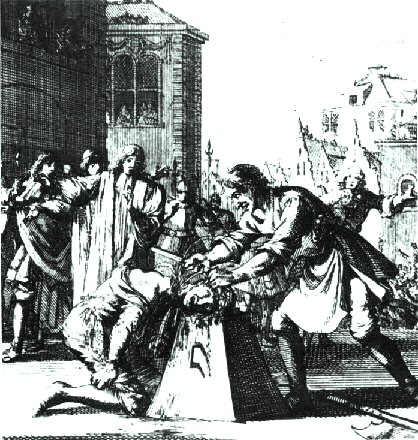
Ketch’s execution of Lord Russell at Lincoln’s Inn Fields on 21 July 1683 was performed clumsily; a pamphlet entitled The Apologie of John Ketch, Esquire contains his apology, in which he alleges that the prisoner did not “dispose himself as was most suitable” and that he was interrupted while taking aim.

On that occasion, Ketch wielded the instrument of death either with such sadistically nuanced skill or with such lack of simple dexterity—nobody could tell which—that the victim suffered horrifically under blow after blow, each excruciating but not in itself lethal. Even among the bloodthirsty throngs that habitually attended English beheadings, the gory and agonizing display had created such outrage that Ketch felt moved to write and publish a pamphlet title Apologie, in which he excused his performance with the claim that Lord Russell had failed to “dispose himself as was most suitable” and that he was therefore distracted while taking aim on his neck.

James Scott, 1st Duke of Monmouth’s execution

On the scaffold on July 15, 1685, James Scott, 1st Duke of Monmouth, addressing Ketch, referred to his treatment of Lord Russell, thus disconcerting him, stating “Here are six guineas for you. Do not hack me as you did my Lord Russell. I have heard that you struck him three or four times. My servant will give you some more gold if you do the work well.” The duke subsequently undressed and felt the edge of the axe expressing some fear that it was not sharp enough, and laid his head on the block.” The first blow dealt by Ketch inflicted only a slight wound after which the Duke struggled, rose from the block, and looked reproachfully at the executioner before sinking down once more. Ketch struck the duke twice more, but still the neck was not severed, and the body continued to move. Yells of rage and horror rose from the onlooking crowd to which Ketch flung down the axe with a curse and stated that “I cannot do it, my heart fails me.” The sheriff present asked Ketch to “Take up the axe, man” to which Ketch responded by once more taking up the axe and dealing two more blows to the duke, killing him.Still, the head remained attached and Ketch used a butcher’s knife from the sheath on his hip to cut the last sinew and flesh that prevented the head from dropping. The crowd was so enraged that Ketch had to be escorted away under strong guard.

Monmouth’s reminder of Russell’s execution either unnerved or angered Ketch. Even as the first blow fell upon the duke, those who counted themselves connoisseurs of the headman’s art knew the axe had missed its mark. Ketch stood back, regarding his botched handiwork, and dealt another blow, then another, as Monmouth writhed, screamed, and moaned. According to the official record of the Tower of London, there were five blows in all, though some onlookers counted seven and others eight. Whether five, seven, or eight, none proved sufficient to sever the man’s head from his suffering body, and Ketch pulled a butcher’s knife from the sheath on his hip, which he drew across the last cords of sinew and flesh that prevented the head from dropping to the scaffold floor. With that, the life of James Scott, 1st Duke of Monmouth, ended on July 15, 1685.

In his Diary, John Evelyn wrote of the duke’s execution that:

He [the duke] would not make use of a cap or other circumstance, but lying down, bid the fellow to do his office better than to the late Lord Russell, and gave him gold; but the wretch made five chops before he had his head off; which so incensed the people, that had he not been guarded and got away, they would have torn him to pieces.

The execution of the duke was considered to be worse than that of Lord Russell. In 1686, Ketch was deposed and imprisoned at Bridewell.

Later life

In 1686 Ketch was sent to prison for “affronting” a sherrif. His job was taken by his assistant, Paskah Rose, formerly a butcher. Rose was arrested after only four months in his office for robbery. Ketch was reappointed in his place and hanged his own assistant at Tyburn.

He died towards the close of 1686.

Fiction

In 1836 a fictitious autobiography of Ketch, with illustrations from designs by Meadows entitled The autobiography of Jack Ketch, was published. Another book entitled Life of Jack Ketch with Cuts of his own Execution was furnished by Tom Hood for the Duke of Devonshire’s library at Chatsworth.

Jack Ketch is one of the characters in Giovanni Piccini (d.1835) The Tragical Comedy or Comical Tragedy of Punch and Judy as dictated to John Payne Collier, in 1828. He is mentioned in the Charles Dickens novel David Copperfield. More recently, Jack Ketch plays a role in Neal Stephenson’s 2004 volume entitled System of the World, which is the last book in his Baroque Cycle.


La Tomatina


La Tomatina  is a festival that is held in theValencian town of Buñol, a town located 30 km inland from the Mediterranean Sea in which participants throw tomatoes and get involved in this tomato fight purely for fun. It is held on the last Wednesday of August, during the week of festivities of Buñol.

History

Origin

In 1945, during a parade of gigantes y cabezudos, young men who wanted to participate in the event staged a brawl in town’s main square, the Plaza del Pueblo. Since there was a vegetable stand nearby, they picked up tomatoes and used them as weapons. The police had to intervene to break up the fight, and forced those responsible to pay the damages incurred.

The following year the young people repeated the fight on the same Wednesday of August, only this time they brought their own tomatoes from home. They were again dispersed by the police. After repeating this in subsequent years, the party was established. In 1950, the town allowed the tomato hurl to take place, however the next year it was again stopped. A lot of young people were imprisoned but the Buñolresidents forced the authorities to let them go. The festival gained popularity with more and participants getting involved every year. After subsequent years it was banned again with threats of serious penalties. In the year 1957, some young people planned to celebrate “the tomato’s funeral”, with singers, musicians, and comedies. The main attraction however, was the coffin with a big tomato inside being carried around by youth and a band playing the funeral marches. Considering this popularity of the festival and the alarming demand, 1957 saw the festival becoming official with certain rules and restrictions. These rules have gone through a lot of modifications over the years.

Another important landmark in the history of this festival is the year 1975. From this year onwards, “Los Clavarios de San Luis Bertrán” (San Luis Bertrán is the patron of the town of Buñol ) organised the whole festival and brought in tomatoes which was being brought by the local people before this. Soon after this, in 1980, the town hall took the responsibility of organizing and making the festival big.

Description

At around 10 AM, festivities begin with the first event of the Tomatina. It is the “palo jabón”, similar to the greasy pole. The goal is to climb a greased pole with a ham on top. As this happens, the crowd work into a frenzy of singing and dancing while being showered in water from hoses. Once someone is able to drop the ham off the pole, the start signal for the tomato fight is given by firing the water shot in the air and trucks make their entry. The signal for the onset is at about 11 when a loud shot rings out, and the chaos begins. Several trucks throw tomatoes in abundance in the Plaza del Pueblo. The tomatoes come from Extremadura, where they are less expensive and are grown specifically for the holidays, being of inferior taste. For the participants the use of goggles and gloves are recommended. The tomatoes must be crushed before being thrown so as to reduce the risk of injury. The estimated no. of tomatoes used are around 150,000 i.e. over 90,000 pounds. After exactly one hour, the fight ends with the firing of the second shot, announcing the end. The whole town square is colored red and rivers of tomato juice flow freely. Fire Trucks hose down the streets and participants use hoses that locals provide to remove the tomato paste from their bodies. Some participants go to the pool of “los peñones” to wash. After the cleaning, the village cobblestone streets are pristine due to the acidity of the tomato disinfecting and thoroughly cleaning the surfaces.

Rules of the festival

The city council follows a short list of instructions for the safety of the participants and the festival:

1.     The tomatoes have to be squashed before throwing to avoid injuries.

2.     No other projectiles except tomatoes are allowed.

3.     Participants have to give way to the truck and lorries.

4.     The festival doesn’t allow ripping off T-shirts.

5.     After the second shot indicative of ending the tomato hurl, no tomatoes should be thrown.

In other countries

La Tomatina Buñol has inspired other similar celebrations in other parts of the world:

§                    Since 2004 the Colombian town of Sutamarchán holds a similar event on the 15th of June when a surplus of tomatoes is harvested.

§                    In Costa Rica the town of San José de Trojas (Valverde Vega Canton) celebrates a tomatine during the local Tomato Fair in February.

§                    In the town of Dongguan in southern Guangdong province in China, a tomato fight is held on the 19th of October, during which they use up to 15 tons of tomatoes.

§                    The City of Reno, Nevada in the United States also has an annual hour long tomato fight that started in 2009. The event seems to take place on the last Sunday of August, and is organized by the American Cancer Society. Organizers also named the festival La Tomatina, and give full credit for the idea to the Spanish festival.

§                    On February 12, 2011, at the field of Esparraguera, town of Quillón, VIIIth Region, Chile, the first version of the Great Tomato War was held under the auspices of the local municipality and a private firm. Like the Spanish Tomatina, it was a playful battle involving young people.

§                    The video game company Namco included a scenario that mimics the Tomatina event in the 6th installment of the saga Tekken fighting game.

§                    Click4specs- an Australian Company have a bi-annual tomato fight where employees are allowed to throw tomatoes at their employers for a one hour period on the first Tuesday of March and October.

§                    The festival was recreated for the song Ik Junoon (Paint it red) from the 2011 Hindi film Zindagi Na Milegi Dobara.

§                    In the Indian state of Karnataka, the Karnataka Government banned the hosting of such a Tomatina event in Bangalore and Mysore, after private organizers tried to organize one. Chief Minister D.V. Sadananda Gowda is quoted as saying: “In the name of ‘La Tomatina’ festival, permission should not be granted to waste tomatoes”. A similar event planned in Delhi was cancelled after it received negative response from the public.

§                    Milwaukee’s East Side Association holds an annual Tomato Romp during September in coordination with a Bloody Mary drink contest. Held since at least 2009 it is limited to 250 people in a caged-in area.

Nok


The Nok culture appeared in Nigeria around 1000 B.C. and mysteriously vanished around 500 AD in the region of West Africa. This region lies in Northern and Central Nigeria. Its social system is thought to have been highly advanced. The Nok culture was considered to be the earliest sub-Saharan producer of life-sized Terracotta. It has been suggested that the Nok civilization eventually evolved into the later Yoruba civilization of Ife based on similarities seen in the artwork from these two cultures.

The refinement of this culture is attested to by the image of a Nok dignitary at the Minneapolis Institute of Arts. The dignitary is portrayed wearing a “shepherds crook” affixed with an elastic material to the right arm . The dignitary is also portrayed sitting with flared nostrils, and an open mouth suggesting performance. other images show figures on horseback, indicating Nok culture had tamed the horse.

Iron use, in smelting and forging for tools, appears in Nok culture in Africa at least by 550 BC and more probably in the middle of the second millennium BC (between 1400 BC and 1600 BC depending on references).

Sculptures

Nok sculptures also depict animals and humans. Their function is still unknown, since scientific field work is still missing. For the most part, the terracotta is preserved in the form of scattered fragments. That is why Nok art is well known today only for the heads, both male and female, whose hairstyles are particularly detailed and refined. The statues are in fragments because the discoveries are usually made from alluvial mud, in terrain made by the erosion of water. The terracotta statues found there are hidden, rolled, polished, and broken. Rarely are works of great size conserved intact making them highly valued on the international art market.

The terracotta figures are hollow, coil built, nearly life sized human heads and bodies that are depicted with highly stylized features, abundant jewellery, and varied postures. Some artifacts have been found illustrating a plethora of physical ailments, including debilitating disease and facial paralysis. Other associated pieces include plant and animal motifs.

Little is known of the original function of the pieces, but theories include ancestor portrayal, grave markers, and charms to prevent crop failure, infertility, and illness. Also, based on the dome-shaped bases found on several figures, they could have been used as finials for the roofs of ancient structures.

Margaret Young-Sanchez, Associate Curator of Art of the Americas, Africa, and Oceania in The Cleveland Museum of Art, explains that most Nok ceramics were shaped by hand from coarse-grained clay and subtractively sculpted in a manner that suggests an influence from wood carving. After some drying, the sculptures were covered with slip and burnished to produce a smooth, glossy surface. The figures are hollow, with several openings to facilitate thorough drying and firing. The firing process most likely resembled that used today in Nigeria, in which the pieces are covered with grass, twigs, and leaves and burned for several hours.

In 1928, the first find was accidentally unearthed at a level of 24 feet in an alluvial tin mine in the vicinity of the village of Nok near the Jos Plateau region of Nigeria (Folorunso 32). As a result of natural erosion and deposition, Nok terracottas were scattered at various depths throughout the Sahel grasslands, causing difficulty in the dating and classification of the mysterious artifacts.

Luckily, two archaeological sites, Samun Dukiya and Taruga, were found containing Nok art that had remained unmoved. Radiocarbon and thermo-luminescence tests narrowed the sculptures’ age down to between 2,000 and 2,500 years ago, making them some of the oldest in West Africa.

Because of the similarities between the two sites, archaeologist Graham Connah believes that “Nok artwork represents a style that was adopted by a range of iron-using farming societies of varying cultures, rather than being the diagnostic feature of a particular human group as has often been claimed.”

Discovery

The Nok culture was discovered in 1928 on the Jos Plateau during tin mining .

Lt-Colonel John Dent-Young, an Englishman, was leading mining operations in the Nigerian village of Nok. During these operations, one of the miners found a small terracotta of a monkey head. Other finds included a terracotta human head and a foot. The colonel, at a later date, had these artifacts placed in a museum in Jos.

In 1932, a group of 11 statues in perfect condition were discovered near the city of Sokoto. Since that time, statues coming from the city of Katsina were brought to light. Although there are similarities to the classical Nok style, the connection between them is not clear yet.

Later still, in 1943, near the village of Nok, in the center of Nigeria, a new series of clay figurines were discovered by accident while mining tin. A worker had found a head and had taken it back to his home for use as a scarecrow, a role that it filled (successfully) for a year in a yam field. It then drew the attention of the director of the mine who bought it. He brought it to the city of Jos and showed it to the trainee civil administrator, Bernard Fagg, an archaeologist who immediately understood its importance. He asked all of the miners to inform him of all of their discoveries and was able to amass more than 150 pieces. Afterwards, Bernard and Angela Fagg ordered systematic excavations that revealed many more profitable lucky finds dispersed over a vast area, much larger than the original site. In 1977, the number of terra cotta objects discovered in the course of the mining excavation amounted to 153 units, mostly from secondary deposits (the statuettes had been carted by floods near the valleys) situated in dried-up riverbeds insavannahs in Northern and Central Nigeria (the Southwestern portion of the Jos Plateau).

Based on discoveries that have been found in an increasingly larger area, including the Middle Niger Valley and the Lower Benue Valley, the physiologist and engineer A. O. Olubunmi argues that proto-Yorubas were the creators of the Nok civilization. He attributes the mystery of the disappearance of the Nok civilization to the disappearance of Yorubas from northern Nigeria due to massacre, expulsion and racial assimilation prior to and following the arrival of Islam.


Matryoshka Doll


A matryoshka doll is a Russian nesting doll (Russian: Матрёшка) which is a set of woodendolls of decreasing size placed one inside the other. The first Russian nested doll set was carved in 1890 by Vasily Zvyozdochkin from a design by Sergey Malyutin, who was a folk crafts painter at Abramtsevo. Traditionally the outer layer is a woman, dressed in a sarafan, a long and shapeless traditional Russian peasant jumper dress. The figures inside may be of either gender; the smallest, innermost doll is typically a baby lathed from a single piece of wood. Much of the artistry is in the painting of each doll, which can be very elaborate. The dolls often follow a theme, aside from the typical traditional peasant girls, the themes vary, from fairy talecharacters to Soviet leaders.

Design

A set of matryoshkas consists of a wooden figure which separates, top from bottom, to reveal a smaller figure of the same sort inside, which has, in turn, another figure inside of it, and so on. The number of nested figures is traditionally at least five, but can be much more, up to several dozen with sufficiently fine craftsmanship. Modern dolls often yield an odd number of figures but this is not an absolute rule; the original Zvyozdochkin set, for instance, had an even number. The form is approximately cylindrical, with a rounded top for the head, tapering toward the bottom, with little or no protruding features; the dolls have no hands (except those that are painted). Traditionally the outer layer is a woman, dressed in a sarafan. The figures inside may be of either gender; the smallest, innermost doll is typically a baby lathed from a single small piece of wood (and hence non-opening). The artistry is in the painting of each doll, which can be extremely elaborate.

The word “matryoshka” (матрёшка), literally “little matron”, is a diminutive form of the Russian female first name “Matryona” (Матрёна).

History

The first Russian nested doll set was carved in 1890 by Vasily Zvyozdochkin from a design bySergey Malyutin, who was a folk crafts painter in the Abramtsevo estate of the Russian industrialist and patron of arts Savva Mamontov. The doll set was painted by Malyutin. Malyutin’s doll set consisted of eight dolls—the outermost was a girl holding a rooster wearing a traditional dress. The inner dolls were girls and a boy, and the innermost a baby.

Zvyozdochkin and Malyutin were inspired by a doll from Honshu, the main island of Japan. Sources differ in descriptions of the doll, describing it as either a round, hollow daruma doll or afukuruma nesting doll portraying portly bald old Buddhist monk.

In 1900, Savva Mamontov’s wife presented the dolls at the World Exhibition in Paris, and the toy earned a bronze medal. Soon after, matryoshka dolls were being made in several places in Russia.

Themes


Matryoshka dolls are often designed to follow a particular theme, for instance peasant girls in traditional dress, but the theme can be anything, from fairy tale characters to Soviet leaders.

Modern artists create many new styles of nesting dolls. Common themes include floral,Christmas, Easter, religious, animal collections, portraits and caricatures of famous politicians, musicians, athletes, astronauts, “robots” and popular movie stars. Matryoshka dolls that feature communist leaders of Russia became very popular among Russian people in the early 1990s, after the collapse of the Soviet Union. Today, some Russian artists specialize in painting themed matryoshka dolls that feature specific categories of subjects, people or nature. Areas with notable matryoshka styles include Sergiyev Posad, Semionovo (now the town of Semyonov), Polkhovsky Maidan, and Kirov.

During Perestroika, the leaders of the Soviet Union became a common theme depicted on matryoshkas. Starting with the largest, Mikhail Gorbachev, then Leonid Brezhnev (Yuri Andropovand Konstantin Chernenko almost never appear due to the short length of their respective terms), then Nikita Khrushchev, Josef Stalin and finally the smallest, Vladimir Lenin. Newer versions start with Dmitry Medvedev and then follow with Vladimir Putin, Boris Yeltsin, Mikhail Gorbachev,Joseph Stalin and then Vladimir Lenin.

As metaphor

Matryoshkas are also used metaphorically, as a design paradigm, known as the “matryoshka principle” or “nested doll principle”. It denotes a recognizable relationship of “object-within-similar-object” that appears in the design of many other natural and man-made objects. Examples include theMatrioshka brain and the Matroska media-container format. The “matryoshka principle” is also an example of Mise-en-abyme. Compare Fractal.

The onion metaphor is of similar character. If the outer layer is peeled off an onion, a similar onion exists within. This structure is employed by designers in applications such as the layering of clothes or the design of tables, where a smaller table sits within a larger table and a yet smaller one within that.

Production

The dolls are constructed from one block of wood, which is essential to their manufacture.

A block of wood is cut in half. Then, a piece of wood is taken out of the top and bottom pieces. This continues until there is very little wood left. The wood is carved into an oval shape. The matching pieces are put together. The pieces are painted and nested inside one another.

Decline in production

Since the 1990s matryoshka dolls have been facing a downward spiral in production. The production of matryoshkas is done by highly skilled craftsmen that have been passing down their skills generation to generation. With factories that produce matryoshkas shutting down there is a fear that these skill use to make matryoshka dolls may be lost because there will be no one to pass the skill along to.


Vampire Squid


The vampire squid (Vampyroteuthis infernalis, lit. “vampire squid from ‘Hell'”) is a small, deep-seacephalopod found throughout the temperate and tropical oceans of the world. Unique retractile sensory filaments justify the Vampire Squid’s placement in its own order: Vampyromorphida(formerly Vampyromorpha), which shares similarities with both squid and octopuses. As aphylogenetic relict it is the only known surviving member of its order, first described and originally classified as an octopus in 1903 by German teuthologist Carl Chun, but later assigned to a new order together with several extinct taxa.

Physical description

The Vampire Squid reaches a maximum total length of around 30 cm (1 ft). Its 15 cm (6 inch) gelatinous body varies in color between velvety jet-black and pale reddish, depending on location and lighting conditions. A webbing of skin connects its eight arms, each lined with rows of fleshy spines or cirri; the inside of this “cloak” is black. Only the distal half (farthest from the body) of the arms have suckers. Its limpid, globular eyes, which appear red or blue, depending on lighting, are proportionately the largest in the animal kingdom at 2.5 cm (1 inch) in diameter. The animal’s dark color, cloak-like webbing, and red eyes are what gave the Vampire Squid its name.

Mature adults have a pair of small fins projecting from the lateral sides of the mantle. These fins serve as the adult’s primary means of propulsion: vampire squid “fly” through the water by flapping their fins. Their beak-like jaws are white. Within the webbing are two pouches wherein the tactile velar filaments are concealed. The filaments are analogous to a true squid’s tentacles, extending well past the arms; however, they are a different arm pair than the squid’s tentacles. Instead, the filaments are the same pair that were lost by the ancestral octopuses.

The Vampire Squid is almost entirely covered in light-producing organs called photophores. The animal has great control over the organs, capable of producing disorienting flashes of light for fractions of a second to several minutes in duration. The intensity and size of the photophores can also be modulated. Appearing as small white discs, the photophores are larger and more complex at the tips of the arms and at the base of the two fins, but are absent from the underside of the caped arms. Two larger white areas on top of the head were initially believed to also be photophores, but have turned out to be photoreceptors.

The chromatophores (pigment organs) common to most cephalopods are poorly developed in the Vampire Squid. While this means the animal is not capable of changing its skin colour in the dramatic fashion of shallow-dwelling cephalopods, such trickery is not needed at the lightless depths where it lives.

Habitat and adaptations

The Vampire Squid is an extreme example of a deep-sea cephalopod, thought to reside at aphotic (lightless) depths from 600–900 metres (2,000-3,000 feet) or more. Within this region of the world’s oceans is a discrete habitat known as the oxygen minimum zone (OMZ). Within the OMZ oxygen saturation is too low to support aerobic metabolism in most higher organisms. Nonetheless, the Vampire Squid is able to live and breathe normally in the OMZ at oxygen saturations as low as 3%; a feat no other cephalopod, and few other animals, can claim.

To cope with life in the suffocating depths, vampire squid have developed several radical adaptations. Of all deep-sea cephalopods, their mass-specific metabolic rate is the lowest. Their blue blood’s hemocyanin binds and transports oxygen more efficiently than in other cephalopods, aided by gills with especially large surface area. The animals have weak musculature but maintain agility and buoyancy with little effort thanks to sophisticated statocysts (balancing organs akin to a human’s inner ear) and ammonium-rich gelatinous tissues closely matching the density of the surrounding seawater.

At the shallower end of the Vampire Squid’s vertical range, the view from below is like the sky at twilight: The highly sensitive eyes of deepwater denizens are able to distinguish the silhouettes of other animals moving overhead. To combat this, the vampire squid generates its own bluish light (bioluminescence) in a strategy called counterillumination: The light diffuses the animal’s silhouette, effectively “cloaking” its presence from the watchful eyes below. Its own large eyes detect even the faintest of gleams. A pair of photoreceptors are located on top of its head, perhaps alerting the animal to movements above.

Like many deep-sea cephalopods, Vampire Squid lack ink sacs. If threatened, instead of ink, a sticky cloud of bioluminescent mucus containing innumerable orbs of blue light is ejected from the arm tips. This luminous barrage, which may last nearly 10 minutes, is presumably meant to daze would-be predators and allow the Vampire Squid to disappear into the blackness without the need to swim far. The display is made only if the animal is very agitated; regenerating the mucus is costly from a metabolic point of view.

Development

Few specifics are known regarding the ontogeny of the Vampire Squid. Their development progresses through three morphologic forms: the very young animals have a single pair of fins, an intermediate form has two pairs, and the mature form again has one. At their earliest and intermediate phases of development, there is a pair of fins located near the eyes; as the animal develops, this pair gradually disappears as the other pair develops.As the animals grow and their surface area to volume ratio drops, the fins are resized and repositioned to maximize gait efficiency. Whereas the young propel themselves primarily by jet propulsion, mature adults find flapping their fins to be the most efficient means. This unique ontogeny caused confusion in the past, with the varying forms identified as several species in distinct families.

If hypotheses may be drawn from knowledge of other deep-sea cephalopods, the Vampire Squid likely reproduces slowly by way of a small number of large eggs. Growth is slow as nutrients are not abundant at depths frequented by the animals. The vastness of their habitat and its sparse population make procreative encounters a fortuitous event. The female may store a male’s hydraulically implanted spermatophore (a tapered, cylindrical satchel of sperm) for long periods before she is ready to fertilize her eggs. Once she does, she may need to brood over them for up to 400 days before they hatch. The female will not eat towards this culmination and dies shortly thereafter.

Hatchlings are c. 8 mm in length and are well-developed miniatures of the adults, with some differences. Their arms lack webbing, their eyes are smaller and their velar filaments are not fully formed. The hatchlings are transparent and survive on a generous internal yolk for an unknown period before they begin to actively feed. The smaller animals frequent much deeper waters, perhaps feeding on marine snow (falling organic detritus).

Behavior

What behavioural data known has been gleaned from ephemeral encounters withROVs; animals are often damaged during capture and survive for no more than about two months in aquaria. An artificial environment makes reliable observation of non-defensive behaviour difficult.

With their long velar filaments deployed, Vampire Squid have been observed drifting along in the deep, black ocean currents. If the filaments contact an entity, or if vibrations impinge upon them, the animals investigate with rapid acrobatic movements. They are capable of swimming at speeds equivalent to two body lengths per second, with an acceleration time of five seconds. However, their weak muscles limit stamina considerably.

Unlike their relatives living in more hospitable climes, deep-sea cephalopods cannot afford to expend energy in protracted flight. Given their low metabolic rate and the low density of prey at such depths, Vampire Squid must use innovative predator avoidance tactics to conserve energy. Their aforementioned bioluminescent “fireworks” are combined with the writhing of glowing arms, erratic movements and escape trajectories, making it difficult for a predator to home in.

In a threat response called “pumpkin” or “pineapple posture”, the Vampire Squid inverts its caped arms back over the body, presenting an ostensibly larger form covered in fearsome-looking though harmless spines (called cirri). The underside of the cape is heavily pigmented, masking most of the body’s photophores. The glowing arm tips are clustered together far above the animal’s head, diverting attack away from critical areas. If a predator were to bite off an arm tip, the Vampire Squid can regenerate it.

Copepods, prawns and cnidarians have all been reported as prey of Vampire Squid. Little else is known regarding their feeding habits, but considering their environment, they are likely to be opportunists. Vampire Squid have been found among the stomach contents of large deepwater fish such as giant grenadiers, and deep diving mammals such as whales and sea lions.

Relationships

The Vampyromorphida are characterized by such apomorphies as the possession of photophores, a peculiar type of uncalcified endoskeleton (the gladius), 8 webbed arms and the 2 velar filaments. Until fairly recently known only from the modern species and somefossil remains tentatively allocated to this group, a batch of Middle Jurassic specimens found at La Voulte-sur-Rhône demonstrated that clearly vampyromorphid cephalopods were in existence for far longer than has been hitherto believed.

These were described as Vampyronassa rhodanica. The supposed vampyromorphids from the Kimmeridgian-Tithonian  of Solnhofen, Plesioteuthis priscaLeptoteuthis gigas, and Trachyteuthis hastiformis, cannot be positively assigned to this group; they are large species and show features not found in vampyromorphids, being somewhat similar to the true squids, Teuthida.

Symbolism

A 2009 Rolling Stone article by Matt Taibbi likened investment bank Goldman Sachs to “a great vampire squid wrapped around the face of humanity, relentlessly jamming its blood funnel into anything that smells like money.” This comparison was later used by other critics of Goldman Sachs, such as the Occupy Wall Street movement.

Skull Symbolism


Skull symbolism is the attachment of symbolic meaning to the human skull. The most common symbolic use of the skull is as a representation of death and mortality, but such a reading varies with changing cultural contexts.

Humans can often recognize the buried fragments of an only partially revealed cranium even when other bones may look like shards of stone. The human brain has a specific region for recognizing faces, and is so attuned to finding them that it can see faces in a few dots and lines or punctuation marks; the human brain cannot separate the image of the human skull from the familiar human face. Because of this, both the death and the now past life of the skull are symbolized.

Moreover, a human skull with its large eye sockets displays a degree of neoteny, which humans often findvisually appealing—yet a skull is also obviously dead. As such, human skulls often have a greater visual appeal than the other bones of the human skeleton, and can fascinate even as they repel. Our present society predominantly associates skulls with death and evil. However, to some ancient societies it is believed to have had the opposite association, where objects like crystal skulls represent “life”: the honoring of humanity in the flesh and the embodiment of consciousness.

Examples

The skull that is often engraved or carved on the head of early New England tombpies might be merely a symbol of mortality, but the skull is also often backed by an angelic pair of wings, lofting mortality beyond its own death.

One of the best-known examples of skull symbolism occurs in Shakespeare’s Hamlet, where the title character recognizes the skull of an old friend: “Alas, poor Yorick! I knew him, Horatio; a fellow of infinite jest. . .” Hamlet is inspired to utter a bitter soliloquy of despair and rough ironic humor.

Compare Hamlet’s words “Here hung those lips that I have kissed I know not how oft” toTalmudic sources: “…Rabi Ishmael [the High Priest]… put [the decapitated head of a martyr] in his lap… and cried: oh sacred mouth!…who buried you in ashes…!”. The skull was a symbol of melancholy for Shakespeare’s contemporaries.

In Elizabethan England, The Death’s-Head Skull, usually a depiction without the lower jawbone, was emblematic of bawds, rakes, Sexual Adventurers and prostitutes; The term Deaths-Head was actually parlance for these rakes, and most of them wore half-skull rings to advertise their station, either professionally or otherwise. The original Rings were wide silver objects, with a half-skull decoration not much wider than the rest of the band; This allowed it to be rotated around the finger to hide the skull in polite company, and to reposition it in the presence of likely conquests.

Skulls and skeletons are the main symbol of the Mexican holiday, Day of the Dead.

Venetian painters of the 16th century elaborated moral allegories for their patrons, andmemento mori was a common theme. The theme carried by an inscription on a rustic tomb, “Et in Arcadia ego”—”I too [am] in Arcadia”, if it is Death that is speaking—is made famous by two paintings by Nicholas Poussin, but the motto made its pictorial debut in Guercino’s version, 1618-22 (in the Galleria Barberini, Rome): in it, two awestruck young shepherds come upon an inscribed plinth, in which the inscription ET IN ARCADIA EGO gains force from the prominent presence of a wormy skull in the foreground.

Next to the Magdalene’s dressing-mirror, in a convention of Baroque painting, the Skull has quite different connotations and reminds the viewer that the Magdalene has become a symbol for repentance. In C. Allan Gilbert’s much-reproduced lithograph of a lovely Gibson Girl seated at her fashionable toilette, an observer can witness its transformation into an alternate image. A ghostly echo of the worldly Magdalene’s repentance motif lurks behind this turn-of-the 20th century icon.

The skull becomes an icon itself when its painted representation becomes a substitute for the real thing. Simon Schama chronicled the ambivalence of the Dutch to their own worldly success during theDutch Golden Age of the first half of the 17th century in The Embarrassment of Riches. The possibly frivolous and merely decorative nature of the still life genre was avoided by Pieter Claesz in his “Vanitas”: Skull, opened case-watch, overturned emptied wineglasses, snuffed candle, book: “Lo, the wine of life runs out, the spirit is snuffed, oh Man, for all your learning, time yet runs on: Vanity!” The visual cues of the hurry and violence of life are contrasted with eternityin this somber, still and utterly silent painting.

When the skull is represented in Nazi SS insignia, the death’s-head (Totenkopf) deals with the fear of death, but when tattooed on the forearm its apotropaic power helps an outlaw biker cheat death. The skull and crossbones signify “Poison” when they appear on a glass bottle containing a white powder, or any container in general. But it is not the same emblem when it flies high above the deck as the Jolly Roger: there the pirate death’s-head epitomizes the pirates’ ruthlessness and despair; their usage of death imagery might be paralleled with their occupation challenging the natural order of things. “Pirates also affirmed their unity symbolically”, Marcus Rediker asserts, remarking the skeleton or skull symbol with bleeding heart and hourglass on the black pirate ensign, and asserting “it triad of interlocking symbols— death, violence, limited time—simultaneously pointed to meaningful parts of the seaman’s experience, and eloquently bespoke the pirates’ own consciousness of themselves as preyed upon in turn. Pirates seized the symbol of mortality from ship captains who used the skull ‘as a marginal sign in their logs to indicate the record of a death'”

When a skull was worn as a trophy on the belt of the Lombard king Alboin, it was a constant grim triumph over his old enemy, and he drank from it. In the same way a skull is a warning when it decorates the palisade of a city, or deteriorates on a pike at a Traitor’s Gate. The Skull Tower, with the embedded skulls of Serbian rebels, was built in 1809 on the highway near Niš, Serbia, as a stark political warning from the Ottoman government. In this case the skulls are the statement: that the current owner had the power to kill the former. “Drinking out of a skull the blood of slain (sacrificial) enemies is mentioned by Ammianus and Livy, and Solinus describes the Irish custom of bathing the face in the blood of the slain and drinking it.” The rafters of a traditionalJivaro medicine house in Peru, or in New Guinea. The temple of Kali is veneered with skulls, but the goddess Kali offers life through the welter of blood. The late medieval and Early Renaissance Northern and Italian painters place the skull where it lies at the foot of the Cross at Golgotha(Hebrew for the place of the skull). But for them it has become quite specifically the skull ofAdam.

The Serpent crawling through the eyes of a skull is a familiar image that survives in contemporaryGoth subculture. The serpent is a chthonic god of knowledge and of immortality, because he sloughs off his skin. The serpent guards the Tree in the Greek Garden of the Hesperides and, later, a Tree in the Garden of Eden. The serpent in the skull is always making its way through the socket that was the eye: knowledge persists beyond death, the emblem says, and the serpent has the secret.

The skull speaks. It says “Et in Arcadia ego” or simply “Vanitas.” In a first-century mosaic tabletop from a Pompeiian triclinium (now in Naples), the skull is crowned with a carpenter’s square and plumb-bob, which dangles before its empty eyesockets (Death as the great leveller), while below is an image of the ephemeral and changeable nature of life: a butterfly atop a wheel—a table for a philosopher’s symposium.

Similarly, a skull might be seen crowned by a chaplet of dried roses, a “Carpe diem“, though rarely as bedecked as Mexican printmaker José Guadalupe Posada’s Catrina. In Mesoamerican architecture,stacks of skulls (real or sculpted) represented the result of human sacrifices. The skull speaks in the catacombs of the Capuchin brothers beneath the church of Santa Maria della Concezione in Rome,where disassembled bones and teeth and skulls of the departed Capuchins have been rearranged to form a rich Baroque architecture of the human condition, in a series of anterooms and subterranean chapels with the inscription, set in bones:

Noi eravamo quello che voi siete, e quello che noi siamo voi sarete.

“We were what you are; and what we are, you will be.”

An old Yoruba folktale tells of a man who encountered a skull mounted on a post by the wayside. To his astonishment, the skull spoke. The man asked the skull why it was mounted there. The skull said that it was mounted there for talking. The man then went to the king, and told the king of the marvel he had found, a talking skull. The king and the man returned to the place where the skull was mounted; the skull remained silent. The king then commanded that the man be beheaded, and ordered that his head be mounted in place of the skull.

In Vajrayana Buddhist iconography, skull symbolism is often used in depictions of wrathful deities and of dakinis.

Mary Elizabeth Bowser


Mary Elizabeth Bowser (c.1839 – unknown) was an educated American freed slave who worked in connection with Elizabeth Van Lew as a Union spy during the American Civil War. Placed as a servant in the home of Confederate States of America President Jefferson Davis at the Confederate White House, she gathered much useful information which was passed on to the Union Army intelligence.

Unsuspected because of her supposed status as an illiterate slave, Bowser was able to gain access to sensitive military information, which she provided to Van Lew both through direct messages and an ingenious system of codes and signals. After three years of spying, she fled Richmond as the war came to a close and was not heard from again.

For centuries, her role as one of the Union’s most effective and courageous spy remained untold. In 1995, she was admitted to the Military Intelligence Hall of Fame as “one of the highest placed and most productive espionage agents of the Civil War.”

Early life

Born in Richmond, Virginia around 1839, Mary Elizabeth (Van Lew) Bowser began her life as a slave on the plantation of John Van Lew, a wealthy hardware merchant. When Mary was very young, her family members were traded away to other masters. John Van Lew then died in 1851, and his daughter, Elizabeth, was a strong abolitionist. She freed Mary and ten other slaves owned by the family. She also bought Mary’s family members and freed them as well. Though free to leave, Mary would remain with the Van Lew family until the late 1850s.

Elizabeth Van Lew noted Mary’s intelligence and arranged for her to be educated at a Quaker school in Philadelphia, where Elizabeth herself had also studied. Mary was attending classes there when the Civil War began. Van Lew, who had already begun working for the Union cause, then sent for Mary to return to Richmond to help with her efforts. Around that time, Mary married a free African American man with the surname of Bowser. However, nothing more is known of her husband, and it does not appear that the couple had children.

Espionage work

Bowser’s espionage work began in 1863, when Elizabeth Van Lew organized a spy ring of 12 people, including not only Mary but also several clerks in the war and navy departments of the Confederacy and a Richmond mayoral candidate. The outspoken and rebellious Van Lew was well known in Richmond society as an abolitionist, but had cultivated a persona as “Crazy Bet,” which she used to her advantage as a cover to deflect attention from her activities coordinating her network of spies.

After Mary’s arrival in Richmond, Elizabeth enlisted her as a spy and devised a plan to place her as close as possible to the top levels of Confederate military planners. Besides her intelligence and a near-photographic memory, Mary apparently possessed considerable skill as an actress. She thus became “Ellen Bond,” an eccentric and uneducated, but highly capable servant, reassuming the position of a slave. Elizabeth convinced a friend to bring Mary with her as a servant to social functions held by Varina Davis, who, as the wife of President Jefferson Davis, was the First Lady of the Confederacy. Mary soon won her confidence and was taken on as a full time domestic worker at the Confederate White House.

Bowser had grown up in Richmond, and she had several other advantages as a spy. At Davis’ house, the servants were taught to be unobtrusive, so it was easy for her to gain information without being noticed. As a supposed slave, she was not expected to be able to read and write and thus was not watched carefully when sensitive documents were left where she could see them. However, thanks to her education, she was able to read military plans and retain the information due to her excellent memory.

As a spy for the Union, Bowser read a number of secret military documents, including lists of troop movements, reports on moving Union prisoners, military strategies, and treasury reports. She also overheard important conversations in the dining room about troop movements and other Confederate plans. She would later write down notes on her findings and pass them either to Elizabeth Van Lew or to a Union agent named Thomas McNiven, who worked out of a local bakery. When the bakery wagon came to the Davis house, Bowser would meet it outside to give him her information. When passing messages directly became risky, Mary sometimes hung wet laundry outside the Confederate White House in a special coded pattern: A white shirt beside an upside-down pair of pants might mean “General Hill moving troops to the west.”

To send this intelligence north, Van Lew at first simply used the mail. However, as the information increased and the possibility of discovery grew, she became more sophisticated and created a system of codes and signals. She also established contact with Union agents who slipped into Richmond on secret missions.

Van Lew also sent her own household servants—though she had freed the family’s slaves, many of them chose to stay with her—northward carrying baskets of innocuous-looking farm produce together with Mary Bowser’s secret information. One method involved several baskets of eggs, one of which contained encoded messages from Bowser inside of several eggshells. Another involved a serving tray loaded with food, with messages concealed in its false bottom. Reports were also hidden inside the shoes of Van Lew’s servants, since not many white people would poke into the soles of muddy shoes worn by an “old colored man” on horseback.

Van Lew sent Bowser’s information directly to Union General Benjamin Butler as well as to General Ulysses S. Grant through her elaborate courier system. It was reportedly so fast and effective that Grant often received flowers still fresh from his spy’s large garden. Grant would later say of Bowser and Van Lew’s efforts: “You have sent me the most valuable information received from Richmond during the war.”

Disappearance and legacy

After nearly three years of spying, in January 1865, as the war was coming to a close, Mary Bowser fled from Richmond. She was never to be heard from again, and her sudden disappearance remains unexplained. Jefferson Davis is known to have suspected a leak from the Confederate White House, and some think that Mary’s work as a spy had finally become suspected. Before she left, Mary reportedly attempted to burn down the Confederate White House, but was unsuccessful. When Richmond fell to the Union, Elizabeth Van Lew was the first person to raise the U.S. flag in the city.

However, Mary Bowser’s story and her role as one of the Union’s most courageous and effective spies remained mostly untold, even in her family. To protect the lives of collaborators, the federal government destroyed its southern espionage records after the war. The Bowser family, apparently fearing recriminations from Confederate sympathizers, rarely discussed her work. Van Lew likewise sought to hide her activities from her neighbors in Richmond.

In 1904, however, Thomas McNiven told his daughter Jeannette about his activities as Mary’s contact and courier. She reported his story to her nephew, Robert Waitt Jr., who set them to writing in 1952.

In the 1960s, Mrs. McEva Bowser was asked by a relative about her husband’s great-great aunt Mary, and she answered: “Well, they don’t ever talk about her cause she was a spy.” Bowser apparently left a diary, which McEva Bowser may have found in 1952 after her mother-in-law died. She said, “I did keep coming across (references to) ‘Mr. (Jefferson?) Davis.’ And the only Davis I could think of was the contractor who had been doing some work at the house. And the first time I came across it I threw it aside and said I would read it again. Then I started to talk to my husband about it, but I felt it would depress him. So the next time I came across it I just pitched it in the trash can.”

Mary Bowser’s story was, thus, reconstructed from research into the Union intelligence operation in the Civil War and from memoirs of her colleagues in the operation. In 1995, she was admitted to the Military Intelligence Hall of Fame in Fort Huachuca, Arizona. During the ceremony, her contribution was described as follows:

Ms. Bowser certainly succeeded in a highly dangerous mission to the great benefit of the Union effort. She was one of the highest placed and most productive espionage agents of the Civil War.


Chinese New Year


The most important holiday for Chinese around the world is undoubtedly Chinese New Year — and it all started out of fear.

The centuries-old legend on the origins of the New Year celebration varies from teller to teller, but they all include a story of a terrible mythical monster who preyed on villagers. The lion-like monster’s name was Nian (年) which is also the Chinese word for “year.”

The stories also all include a wise old man who counsels the villagers to ward off the evil Nian by making loud noises with drums and firecrackers and hanging red paper cutouts and scrolls on their doors because for some reason, the Nian is scared of the color red.

The villagers took the old man’s advice and the Nian was conquered. On the anniversary of the date, the Chinese recognize the “passing of the Nian” known in Chinese as guo nian (过年), which is also synonymous with celebrating the new year.

Based on the Lunar Calendar

The date of Chinese New Year changes each year as it is based on the lunar calendar. While the western Gregorian calendar is based on the earth’s orbit around the sun, China and most Asian countries use the lunar calendar that is based on the moon’s orbit around the earth. Chinese New Year always falls on the second new moon after the winter solstice. Other Asian countries such as Korea, Japan and Vietnam also celebrate new year using the lunar calendar.

While both Buddhism and Daoism has unique customs during the New Year, Chinese New Year is far older than both religions. Like many agrarian societies, Chinese New Year is rooted in much a celebration of spring just like Easter or Passover.

Depending on where rice is grown in China, the rice season lasts from roughly May to September (north China), April to October (Yangtze River Valley), or March to November (Southeast China). The New Year was likely the start of preparations for a new growing season.

Spring cleaning is a common theme during this time, as many Chinese will clean out their homes during the holiday. The New Year celebration could even have been a way to break up the boredom of the long winter months.

Traditional Customs

On this day, families travel long distances to meet and make merry. Known as the “Spring movement” or Chunyun (春运), a great migration takes place in China during this period where many travelers brave the crowds to get to their hometowns.

Though the holiday is only about a week-long, traditionally it is a 15-day holiday during which firecrackers are lit, drums can be heard on the streets, red lanterns glow at night, and red paper cutouts and calligraphy hangings are hung on doors. Celebrations conclude on the 15th day with the Lantern Festival.

Children are also given red envelopes with money inside. Many cities around the world also hold New Year parades complete with a dragon and lion dance.

Food is an important component to New Year. Traditional foods include nian gao or sweet sticky rice cake and savory dumplings – which are round and symbolize never-ending wealth. For more about Chinese New Year foods visit About.com’s Chinese Food site.

Chinese New Year vs. Spring Festival

In China, New Year celebrations are synonymous with “Spring Festival” (春节 or chūn jié) and it is typically a week-long celebration.

The origins of this renaming from “Chinese New Year” to “Spring Festival” is fascinating and not widely known.

In 1912, the newly-formed Chinese Republic, governed by the Nationalist party, renamed the traditional holiday to Spring Festival in order to get the Chinese people to transition to celebrating the Western New Year instead.

During this period, many Chinese intellectuals felt that modernization meant doing all the things as the West did.

When the Communists took over power in 1949, the celebration of New Year was viewed as feudalistic and seeped in religion — not proper for an atheist China. Under the Chinese Communist Party, there were some years where New Year was not celebrated at all.

By the late 1980s, however, as China began liberalizing its economy, Spring Festival celebrations became big business.

China Central Television has held an annual New Year’s Gala since 1982, which was and is still televised across the country and now via satellite to the world.

A few years ago, the government announced that it would shorten its holiday system. The May Day holiday would be shortened from a week to one day and the National Day holiday would be made two days instead of a week. In their place, more traditional holidays such as the Mid-Autumn Festival and Tomb-Sweeping Day might be implemented.

The only week-long holiday that was maintained is Spring Festival. Perhaps even today, several millennia after the first New Year, the fear of the Nian is alive and well.